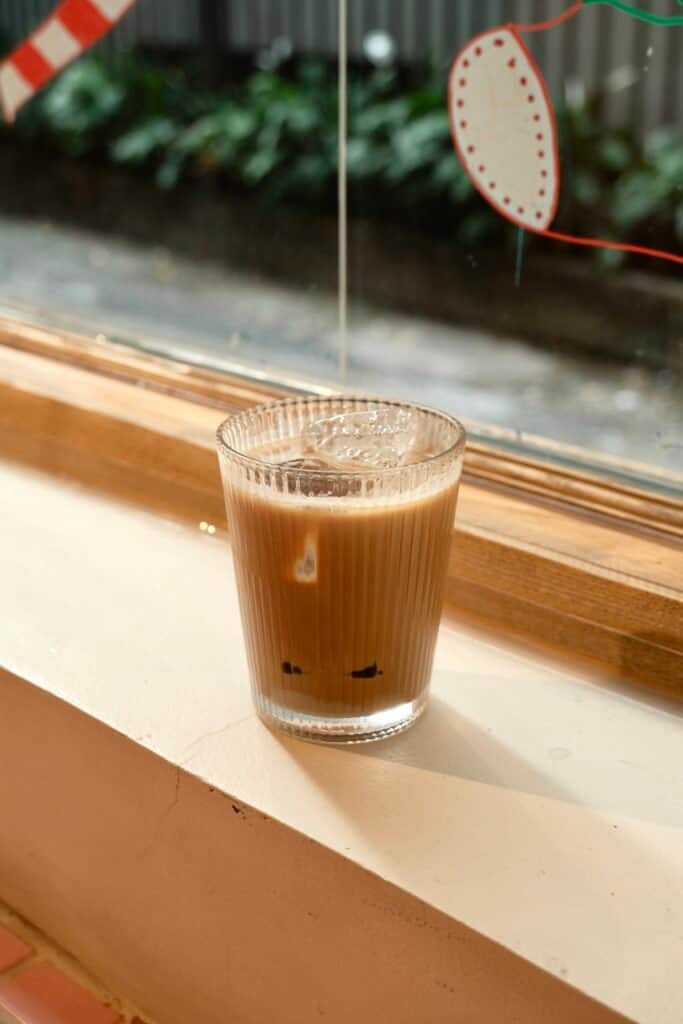
The short answer: Ca phe phin in Saigon is coffee slow-dripped through a metal filter, and ours is 100% honey-processed Robusta. Alongside it we pull espresso from a 70/30 Robusta-Arabica blend roasted locally by Cà Kể. Both are served daily at our District 3 bakery in Bàn Cờ Ward, and the phin is bottled to take away.
What is ca phe phin?
A small metal filter that sits on top of the cup and drips.
There is no pressure and no paper. Ground coffee goes in, a perforated press plate goes on top, hot water goes over it, and then you wait four or five minutes while it works its way through. The grind is coarser than espresso and the contact time is far longer, which is why the result is so concentrated.
It is a slow way to make coffee, and the waiting is part of what it is. Nobody makes a phin in a hurry.
The filter also does something a paper cone cannot. Paper traps the coffee oils; a perforated metal plate lets them straight through into the cup. That is a large part of why a phin has the weight it does on the tongue, and why it holds up under condensed milk without disappearing. Take the same beans through a pour-over and you get a cleaner, thinner, more aromatic cup that would be lost the moment milk arrived.
Why honey-processed Robusta rather than ordinary Robusta?
Because Robusta’s reputation is mostly a processing problem, not a bean problem.
Robusta carries roughly twice the caffeine of Arabica and a heavier body, which is exactly what a phin wants. What it also often carries, in the cheapest form, is a flat rubbery bitterness. That is what people mean when they say they do not like Vietnamese coffee, and they are usually describing a cheap bean roasted dark to hide it.
Honey processing changes that. The sticky mucilage of the coffee cherry is left on the bean while it dries, rather than being washed off, and the sugars in it work into the bean as it cures. What comes out is still unmistakably Robusta, still heavy, but the bitterness reads as dark chocolate instead of as rubber.
Ours comes from RobustaHoney, and it is 100% Robusta with no Arabica cut into it.
It drips slowly. It is dark. It is stronger than most people expect on the first cup.
Because we know how hard it lands, we bottle it. You can take it black or cut with hazelnut, and a bottle means you can drink half now and put the cap back on, which is a more sensible plan than most people make at nine in the morning.
Why a blend on the espresso machine?
Because neither pure bean survives a milk drink here.
A 100% Robusta espresso shot is punishing. Under pressure, all that body and caffeine concentrates into something most people cannot finish. Go the other way to 100% Arabica and the opposite problem appears: it disappears entirely under the milk of a cappuccino, and it stands no chance at all against our house-made chai syrup.
So we went to Cà Kể, a specialty roastery here in Saigon, and settled on their 70/30 Robusta-Arabica split. They source Fine Robusta and Arabica from Sơn La in the north and Đà Lạt in the highlands.
The 70 gives the shot the dark, heavy backbone people here expect from coffee. The 30 lifts it and adds enough aromatic complexity that a flat white tastes like a flat white rather than like strong syrup. It also holds its shape in a dirty chai, which was the hardest drink on the menu to get right.
Which one should you order?
Depends less on where you are from than you would think.
The expected pattern is that visitors order the phin because they came for the Vietnamese thing, and expats order the espresso because they want the drink they know. That was true when we opened and it is not true now.
What actually happened is that our Vietnamese regulars increasingly walk past the espresso machine and buy the bottled phin. They know what clean Robusta tastes like and they can tell that this is not the usual cart coffee. Meanwhile a fair number of visitors order a flat white, because after three days of strong coffee a person wants a rest.
Practical guidance instead of cultural guidance: order the phin if you want concentration and you have time to sit with it, or if you want something to take away and drink over a couple of hours. Order the espresso if you want milk in it, or if you are pairing it with something sweet, because a milk drink sits better against a cookie than a phin does.
How do you order coffee in District 3?
Both run all day at 382/15 Nguyễn Thị Minh Khai, Bàn Cờ Ward, District 3, open daily 8 AM to 9 PM. Bottled phin is on the shelf to take away, and the rest of the drinks list is on the menu.
Delivery across Ho Chi Minh City:
- Direct: order.ipos.vn
- Apps: GrabFood and ShopeeFood
For an office run or a bulk bottle order, message us on Zalo at 0903 305 993.
One note on delivery: bottled phin travels perfectly and is arguably better cold. A milk-based espresso drink does not, and we would rather you drank that one here.
If you want the wider drinks picture, including the matcha and the sodas, we wrote about those separately.
What do customers say about the coffee?
“Delicious treats and great coffee. Friendly staff.”
James F. · Google ★★★★★“Very good coffee shop with a nice variety in cakes and pastries.”
Ricardo S. · Google ★★★★★
Frequently asked questions
What is ca phe phin?
Vietnamese drip coffee made in a small metal filter that sits over the cup. Coarse grounds, no pressure, four to five minutes of drip time. The result is concentrated.
What does honey-processed mean?
The sticky mucilage of the coffee cherry is left on the bean while it dries instead of being washed off. The sugars work into the bean as it cures, which softens Robusta’s harsher bitterness into something closer to dark chocolate.
Is your phin coffee 100% Robusta?
Yes, 100% honey-processed Robusta from RobustaHoney, with no Arabica blended in.
What blend do you use for espresso?
A 70/30 Robusta-Arabica blend roasted by Cà Kể here in Saigon, using Fine Robusta and Arabica from Sơn La and Đà Lạt. The Robusta gives the shot its body and the Arabica keeps it from vanishing under milk.
Can I buy phin coffee to take away?
Yes. We bottle it, black or cut with hazelnut, and it travels well. It is also good cold, so a bottle does not need drinking immediately.
Find us
Dulce de Saigon · 382/15 Nguyễn Thị Minh Khai, Bàn Cờ Ward, District 3, Ho Chi Minh City
Open daily 8 AM to 9 PM · 0903 305 993 · 4.8★ on Google
About the author: Garret Nelson is co-founder of Dulce de Saigon and a longtime Saigon F&B operator. He set up both the phin programme with RobustaHoney and the Cà Kể espresso blend. More at our story.
Explore more from Dulce
- The full Dulce menu
- Cookies in Saigon
- Specialty coffee, matcha and sodas in District 3
- What from-scratch actually means here
Order From Dulce de Saigon
Enjoy our fresh-baked treats delivered directly to your door or visit us in District 3.